Biocultural Restoration, entering a new chapter.

Along the Skykomish River, a group of people camped out and restored a riverscape together, along the way discovering new roles and relationships with one another and the land.

A watercolor view across forested South Puget Sound toward a snow-capped mountain

From Skykomish to South Puget Sound

How do we enable ecological and social restoration at the scales this moment requires?

At Skykomish, the site of a first biocultural restoration field-station experiment, the land became the setting for a temporary world of stewardship. Real ecological work, recurring camp-outs, and emergent individual roles created a doorway for people to participate in the care of a place in new ways. The field station gave people a common setting in which stewardship could become something lived out together.

But when people went home, many of the roles, relationships, and shared practices that had taken shape on the land were left behind.

Work toward a second-generation of this living experiment has begun in South Puget Sound. The aim is to create more field stations, open more pathways into stewardship, and explore ways the stewardship world that emerges can spread across the landscape and into everyday life.
A living geography

South Puget Sound

South Puget Sound is a landscape of rivers and creeks, wetlands and forests, farms, shorelines and inlets, people, communities, and institutions.

Across that landscape, biocultural restoration field stations are being developed as places for restoration, learning, participation, and connection. This mapping aims to connect them into a more visible and participatory network, creating pathways between places, ways to keep learning over time, and more adventures and challenges. It can also help people see the wider world of restoration and stewardship across South Puget Sound.

Here are some of the stories, places, and ways in.

Show on the map

Stewardship Navigation

Where We Are Now

What South Puget Sound is learning

  • Skykomish showed the power of real ecological work, recurring presence, clear roles, recreation, and shared participation.
  • It also showed how much continuity depended on a few people.
  • The deeper challenge may be the human social system: how people enter, remain connected, grow in skill and responsibility, and become part of a durable social body.

How South Puget Sound is learning

  • Learning from what actually happened at Skykomish.
  • Bringing that learning into the emerging South Puget Sound work.
  • Making roles, relationships, possibilities, tensions, and unknowns visible enough to discuss and improve together.

Adaptation Episodes

The path we’re on

  1. Skykomish Biocultural Restoration Field StationA historical field-station experiment built around recurring ecological work, learning, camping, recreation, and building skills.
  2. The field-station stewardship patternThe emergence of complementary roles for land access, site stewardship, community stewardship, institutional support, and technical knowledge.
  3. Learning how the shared world persistsThe recognition that relationships, learning, identity, and responsibility need ways to continue after people go home.
  4. Translating the model toward South Puget SoundThe emerging effort to build a more distributed and durable second generation of the model.
  5. A South Puget Sound field-station experimentMeyer’s Point and other possible sites offer a setting for exploring how multiple field stations could eventually become a connected network.

Change through time

What is changing

  • From a single meaningful field station toward a more distributed landscape of places, people, and stewardship roles.
  • From episodic gatherings toward continuity between gatherings.
  • From participation centered on gatherings toward ongoing pathways of learning, contribution, skill, and responsibility.
  • From one place toward the possibility of a wider landscape of connected stewardship.

Near-term attention

Where we’re putting our attention

Longer-term direction

Where we’re headed

  1. Ground the next field-station work. Clarify Meyer’s Point and other possible sites, relationships, organizational roles, and what is actually active now.
  2. Connect participation to real ecological research and restoration. Build from scientific work including riparian agroforestry, monitoring and adaptive management, evaluating ecosystem services under different management approaches, and identifying where best-available science is strong or where real-world experimentation is still needed.
  3. Develop the Site Steward pathway. Explore how people can enter through real work, gain ecological knowledge and practical skill, return, take on greater responsibility, and become increasingly capable stewards.
  4. Explore stewardship deputization. Explore how conservation institutions can responsibly share tools, knowledge, access, legitimacy, resources, and bounded authority with people outside the formal institution who are prepared to accept real responsibility and accountability.
  5. Begin building continuity between gatherings. Learn what relationships, communication, roles, learning, and social organization are needed for people to remain connected to the work after they leave the field station.
  6. Make the stewardship landscape visible. Begin connecting real places, ecological research, restoration efforts, stories, people, and opportunities so the wider South Puget Sound stewardship world becomes easier to see and navigate.
  • Deeper pathways into stewardship. Make entry easy while creating real pathways toward ecological knowledge, skill, contribution, trust, responsibility, and meaningful stewardship roles.
  • Deputized community stewardship. Learn how increasingly capable stewards can work alongside established institutions, with appropriate support, accountability, and bounded authority, expanding restoration capacity without requiring institutions themselves to carry every function.
  • Restoration as ongoing inquiry. Connect field stations to real ecological research, monitoring, and adaptive management so restoration sites become places where people can test practices, learn from changing conditions, identify gaps in current knowledge, and improve how riverscape forests and wetlands are restored over time.
  • A connected landscape of field stations. Learn how multiple field stations can become nodes in a wider South Puget Sound network, connected through shared learning, stewardship roles, ecological knowledge, and pathways for participation.
  • Durable local support. Explore how public restoration resources, productive agroforestry, institutional capacity, philanthropy, and eventually recurring local support can reinforce the social infrastructure required for long-term stewardship.
  • A durable social body. Grow beyond a succession of projects and gatherings toward a persistent community of stewardship that can hold relationships, identity, learning, membership, responsibility, access, and continuity over time.
  • A rivershed increasingly capable of tending itself. Grow toward a whole rivershed becoming more capable of learning, adapting, and caring for itself through the people and institutions who inhabit it.

Returning Home

How anyone can enter into participation and deepen from there

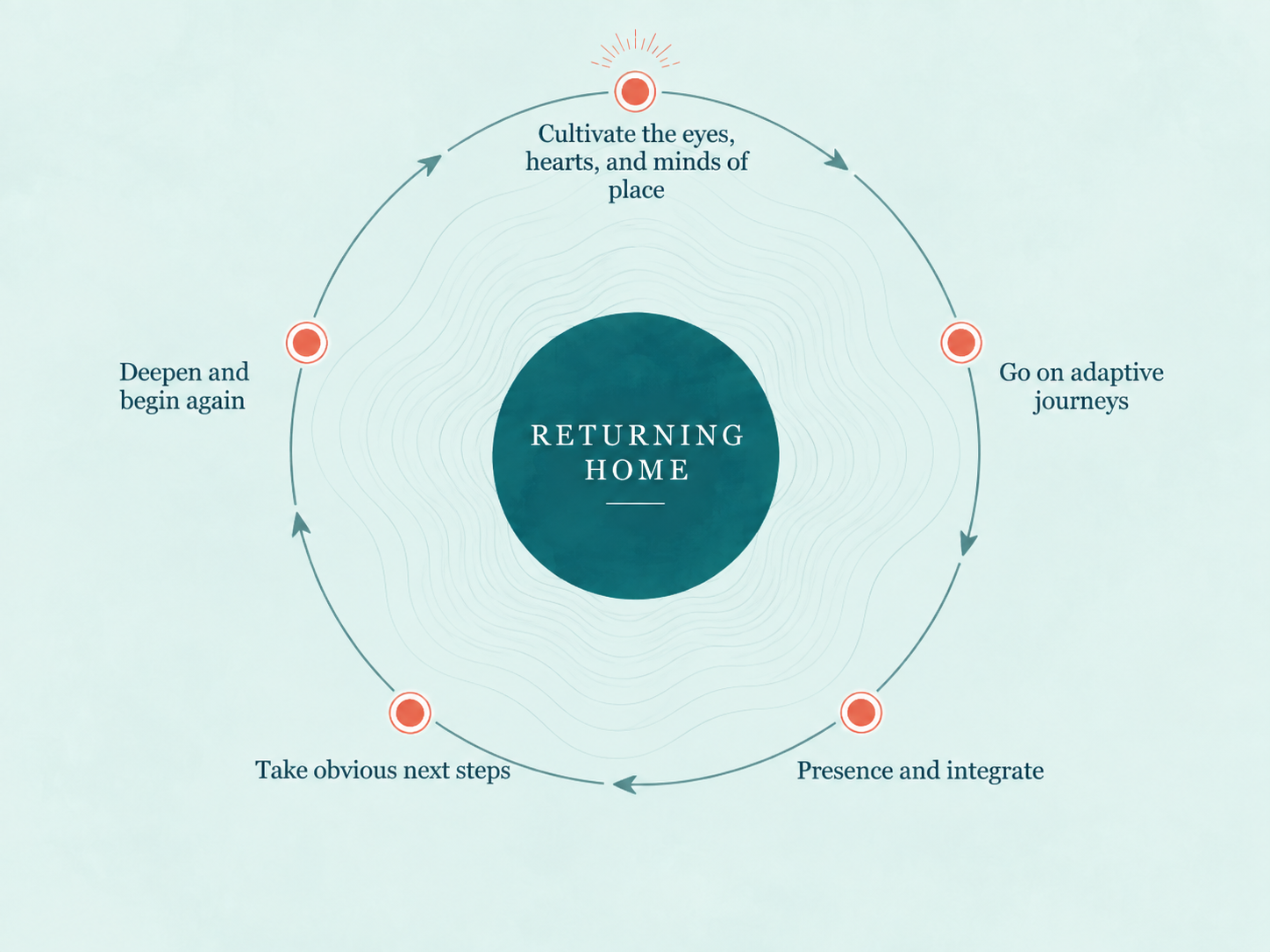
Returning Home is an emerging pathway for helping people pay attention to, befriend, and learn about the life of a place, then find meaningful ways to contribute.

Returning Home cycle

Universal entry point

Returning Home offers everyone a place to begin deepening relationship with place, whether or not they are already connected to a stewardship group or network. You can begin with the Returning Home Adventure podcast here.

Developing

A pathway is beginning to take shape in which people could enter through real ecological work, return over time, build relationships and practical skill, and gradually move into deeper roles, contribution, and responsibility.

Not yet clear

What still needs to be worked out is what helps people return and deepen, how skill and readiness are recognized, and how deputization and a durable social body could support continuity between gatherings.

The view remains partial

Much of what is happening in South Puget Sound remains unseen here.

This first picture comes from a limited body of existing work and perspectives. It cannot represent the full landscape of people, restoration efforts, relationships, knowledge, and possibilities across South Puget Sound, but we'll reveal more as time goes on.

Open questions

  • Who else is already part of the local stewardship landscape that could somehow be involved?
  • Which parts of the Skykomish model should carry forward, and which should change?
  • What would help the shared world persist between gatherings?
  • How can people move from first participation toward deeper skill, contribution, and responsibility?
  • How might institutions responsibly share resources, knowledge, access, and bounded authority?
  • What would make participation genuinely meaningful, compelling, and worth returning to?